

The term "registrars doctors" sits at the intersection of training and service delivery. In Australia, registrars are neither junior doctors still learning the fundamentals nor consultants who have finished their college exams. They occupy the middle ground: doctors with several years of clinical experience who are working toward specialist qualifications while providing essential hospital cover. For hospitals, registrars doctors form the backbone of many rosters, particularly in procedural specialties and high-acuity units. For recruitment agencies and medical staffing coordinators, understanding the distinction between unaccredited and accredited registrars, the credentialling standards they must meet, and the expectations around training time versus service provision is not academic. It determines who you can place, where, and under what terms.
What Defines Registrars Doctors
A registrar is a doctor who has completed internship and resident medical officer (RMO) years and is now training in a recognised specialty program. The exact title varies by hospital and state, but the role is consistent: registrars doctors are expected to manage acute presentations, perform procedures, supervise junior staff, and contribute to the teaching program, all while working toward college fellowship. In New South Wales and Victoria, the term "registrar" is standard. In Queensland and Western Australia, you may also encounter the term "senior registrar" or "advanced trainee" for those closer to completing their training.
Unaccredited registrars are doctors working in registrar-level positions but not enrolled in formal college training. They may be building experience before applying for an accredited post, or they may be working outside a training pathway entirely. Accredited registrars (also called "accredited trainees") are enrolled in a college program and their time in that role counts toward their Certificate of Completion of Training (CCT). The distinction matters for locum placement because accredited registrars often require specific supervision arrangements, educational leave provisions, and training time protected in their rosters.

The Royal College of Obstetricians & Gynaecologists provides clear guidance on what completion of registrar training involves and what certification pathways exist in comparable jurisdictions. While the RCOG framework is UK-based, the principles around structured training, competency assessment and portfolio progression apply equally to Australian college programs run by RACS, ANZCA, ACEM and RANZCOG.
Specialty-Specific Variations
Registrars doctors in anaesthetics spend their training years rotating through theatres, ICU, pain medicine and pre-admission clinics. ANZCA training is five years minimum, often extended if time is taken out for research or if certain competencies take longer to demonstrate. Emergency medicine registrars under ACEM training rotate between metro emergency departments, regional hospitals and retrieval services. Their rosters are shift-based and typically include weekend and night work from day one of training.
Surgical registrars face the longest training pathway. RACS requires a minimum of four to six years depending on the surgical specialty, and competition for accredited positions is high. Unaccredited surgical registrars may work several years in service registrar roles before securing a training number. Obstetrics and gynaecology follows a similar pattern under RANZCOG: six years of accredited training with mandatory rural and subspecialty rotations.
Paediatric registrars under RACP training rotate through general paediatrics, neonatal intensive care, community paediatrics and subspecialty terms. Training is a minimum of three years basic training plus three years advanced, and many registrars pursue additional fellowship training in areas like cardiology or oncology after obtaining their CCT.
Locum Placement for Registrars Doctors
Hospitals need locum registrars doctors for several predictable reasons: parental leave, study leave, sick leave, or gaps between permanent appointments. Locum registrars are also used to cover roster shortfalls when permanent staff numbers don't meet service demand, particularly in regional hospitals where recruitment is difficult. Unlike locum consultants, who can often work autonomously, registrars require appropriate supervision and induction regardless of how experienced they are.
A locum registrar stepping into an emergency department on a Saturday night needs to know where resus equipment is stored, how to activate the trauma call, who the consultant on call is, and what the expected escalation pathway looks like. Agencies that place registrars doctors without arranging a pre-shift orientation or confirming supervision arrangements create risk for both the doctor and the facility.
Best Practice Medical's Registrar and JMO Placement service operates across NSW metro public and private hospitals with secondary coverage across regional and interstate facilities. The consultants understand the difference in environment between a metropolitan teaching hospital and a regional base hospital, and they brief doctors accordingly before they start. That upfront work prevents the call at 2 a.m. when a locum registrar realises they don't have ICU backup or can't find the on-call anaesthetist.

When placing accredited registrars on locum shifts, training time becomes a consideration. If a registrar is working locum shifts while enrolled in an accredited program, those shifts need to be logged appropriately and may require retrospective approval from their Director of Training. Agencies that don't flag this upfront risk placing a doctor in a position that doesn't count toward their training time or, worse, creates a conflict with their college requirements.
Credentialling Standards
Every registrar placed through a locum agency should have current AHPRA registration, medical indemnity insurance appropriate for their scope of practice, and evidence of relevant procedural skills. For anaesthetics registrars, that means documented evidence of airway management, regional anaesthesia and critical incident training. For surgical registrars, it means logbook evidence of relevant procedures and supervision sign-offs.
The BMJ careers guide to NHS pay for doctors outlines how specialty registrars fit into pay structures and what documentation is required at each stage of training. While NHS frameworks differ from Australian award structures, the underlying credentialling principles are identical: you prove competency before you perform the procedure.
Before any doctor is placed, verification of AHPRA registration, medical indemnity insurance, relevant college memberships and facility-specific requirements must occur. The process is managed in-house with clinical oversight, ensuring credentialling standards are independently audited annually. ISO 9001:2015 certification means the process is reviewed at system level, not just on a case-by-case basis.
Roster Design and Working Hours
Rosters for registrars doctors must balance service provision with training requirements, fatigue management and safe working limits. The BMA guidance on managing rotas and duty rosters emphasises prospective roster planning, adequate rest periods and clear escalation pathways when rosters become unsafe. Australian industrial awards contain similar provisions, though enforcement varies by state and hospital.
Most registrars doctors work a combination of day shifts, evening shifts, night shifts and on-call periods. In procedural specialties like anaesthetics or obstetrics, rosters may include theatre sessions, ward rounds, clinic time and after-hours cover. Surgical rosters often involve long days in theatre followed by ward cover overnight. Emergency medicine rosters are typically shift-based with fixed start and end times, though handover can extend those boundaries.
Safe roster design requires enough registrars to cover leave, training time and service demand without relying on repeated back-to-back shifts or excessive overtime. When hospitals understaff their registrar rosters, locum agencies are called to fill gaps reactively. That creates cost inefficiency and reduces continuity of care. Partial or full roster management services allow hospitals to plan ahead, identify gaps early and maintain cover without constant firefighting.
Training Time Protection
Accredited registrars are entitled to protected training time as part of their employment terms. That usually means one or two half-days per week for teaching, self-directed learning or research. Hospitals that cancel training time repeatedly to cover service gaps breach training agreements and risk losing college accreditation for their program.
When placing locum registrars doctors into positions where they are backfilling an accredited trainee, it is worth confirming whether training time needs to be factored into the roster. If the permanent registrar had Wednesday afternoon protected for teaching, the locum covering that role may be expected to provide the same service hours elsewhere in the week. Agencies that don't clarify this upfront cause confusion and create tension between the locum, the department and the training supervisor.
The UK government's education and training tariffs guidance outlines funding arrangements for registrar training posts and what tariff contributions cover in terms of supervision, training and study leave. While tariff structures don't apply in Australia, the same cost components exist: hospitals that employ registrars carry the cost of supervision, education and reduced service availability when training time is protected.
Pay, Conditions and Contract Terms
Registrars doctors are typically paid according to state health award rates or enterprise agreements. In New South Wales, registrars employed under the NSW Health medical officers' award are classified as Level 2 or Level 3 depending on experience and accreditation status. Pay includes a base salary plus penalty rates for after-hours work, on-call allowances and higher duties allowances if acting in a more senior capacity.
The NHS Employers overview of medical and dental pay structure explains how specialty registrar pay is structured across the UK, including banding supplements and out-of-hours enhancements. Australian award structures follow a similar model, with penalty loadings for evenings, nights, weekends and public holidays.
Locum registrars working through agencies are often paid an hourly rate negotiated between the agency, the hospital and the doctor. That rate should be equivalent to or better than award conditions after accounting for leave loading, superannuation and other entitlements that permanent staff receive. Agencies that undercut award rates to win contracts create downward pressure on the entire locum market and disincentivise experienced registrars from accepting locum work.
When a locum registrar is placed on an extended contract (parental leave cover, for example, or a six-month gap while a permanent appointment is recruited), the same credentialling process applies regardless of duration. That gives hospital clients consistency and confidence across a multi-week or multi-month arrangement.
Burnout and Workload
Research published in Frontiers examining burnout among diabetes specialist registrars found significant prevalence of emotional exhaustion, depersonalisation and reduced personal accomplishment among mid-level trainees. The study identified workload intensity, inadequate supervision and lack of control over working hours as primary drivers. Those findings are not unique to diabetes training or to the UK. Australian registrars face similar pressures, particularly in under-resourced departments.
Locum agencies have a role in mitigating burnout by ensuring accurate job descriptions, realistic rostering and proper handover arrangements. When a locum registrar is told they will be working a standard day shift and then discovers they are expected to cover evening ward calls with no senior support, that is a recruitment failure. Registrars doctors leave locum agencies when they feel misled or unsupported, and hospitals lose access to a pool of experienced clinicians who could otherwise fill gaps at short notice.
Interstate and Regional Considerations
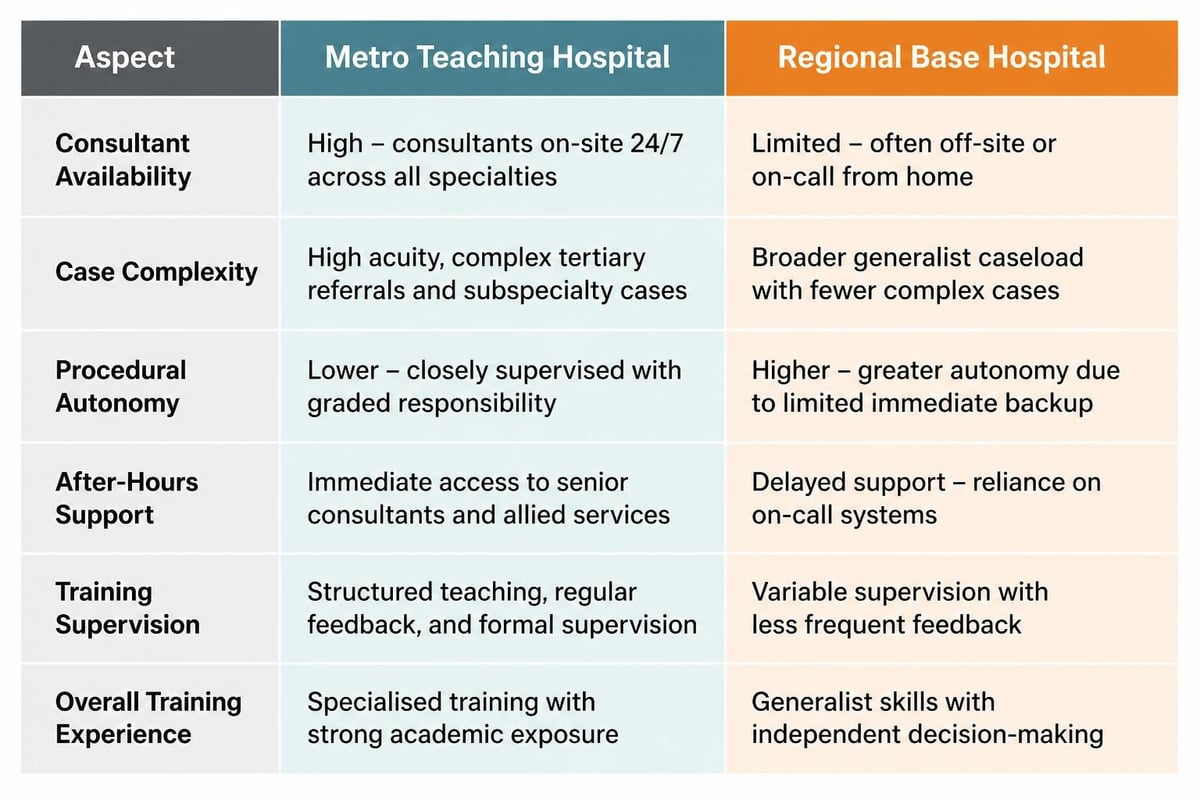
Registrars doctors who take locum work interstate or in regional hospitals face logistical and clinical challenges that metro placements don't involve. Travel, accommodation, unfamiliar hospital systems, reduced consultant backup and different case mixes all require planning. Agencies that manage travel and accommodation logistics for placed doctors remove that administrative burden from the doctor and the receiving facility. All arrangements should be confirmed before the doctor departs.
Regional hospitals often have smaller teams and fewer specialty resources. A locum anaesthetics registrar in a metropolitan tertiary hospital may have access to three or four consultant anaesthetists on site at any time. The same registrar working in a regional base hospital might be the only anaesthetist in the building after hours, with consultant backup available by phone. That is a different level of responsibility and requires a different skill set.
Before placing a registrar into a regional or interstate role, agencies should confirm the level of supervision available, the expected case mix, and what escalation pathways exist for complex or unfamiliar presentations. Registrars doctors who are told they will have senior support and then find themselves managing cases beyond their competency become risk-averse, delay necessary interventions, or leave the placement early. None of those outcomes benefit the doctor, the hospital or the patients.
Credentialling for Regional and Interstate Placements
Interstate placements require verification that AHPRA registration is current and unrestricted in the destination state. Most registrars hold general registration without conditions, but some may have conditional registration tied to a specific training program or hospital. Agencies that place a doctor interstate without checking registration status create medico-legal risk and potentially invalidate the doctor's indemnity cover.
Regional hospitals may have specific credentialling requirements beyond AHPRA registration. Some require evidence of ACLS, APLS or EMST certification. Some require procedural logbooks or supervisor references. Agencies that gather this documentation upfront and submit it to the hospital's medical workforce unit before the doctor's first shift avoid last-minute delays and reduce the administrative load on both sides.
Specialty-Specific Demand Patterns
Demand for locum registrars doctors varies by specialty and by time of year. Emergency medicine experiences peaks during winter (influenza season, respiratory presentations) and summer (trauma, drownings, heat-related illness). Anaesthetics and surgical specialties see demand linked to elective theatre lists: when theatres are running at capacity and permanent staff are on leave, locum registrars are needed to maintain throughput.
Obstetrics and gynaecology demand is less seasonal but highly sensitive to unexpected leave. A single registrar going on parental leave or sick leave can destabilise an entire roster, particularly in smaller units. Paediatric demand spikes during school holidays when permanent staff take leave, and during viral seasons when ward admissions increase.
Psychiatry registrar demand is more stable but harder to fill. There are fewer psychiatry registrars overall, and locum rates often lag behind procedural specialties. Agencies that specialise in psychiatry placements build relationships with registrars early in their training and maintain contact throughout their career progression. That continuity creates a reliable supply of locum doctors who know the agency, trust the briefing process, and are willing to take short-notice shifts.
Pay Structures and Benchmarking
Locum rates for registrars doctors should reflect award entitlements, experience level, specialty and shift type. A first-year anaesthetics registrar working a weekday day shift will be paid less than a final-year surgical registrar covering a weekend night shift. Agencies that apply flat hourly rates regardless of these variables either overpay inexperienced registrars (creating cost inefficiency for hospitals) or underpay experienced registrars (driving them to competing agencies).
Transparent rate cards that break down base hourly rate, penalty loadings, on-call allowances and overtime thresholds allow doctors and hospitals to understand what they are paying or being paid. When an agency quotes a single figure without explanation, it creates mistrust and makes it difficult to compare offers across agencies.
The NHS medical and dental pay structure guide provides a useful framework for understanding how specialty registrar pay bands are constructed and what components make up total remuneration. Australian award structures follow similar logic: base salary, penalty rates, allowances and higher duties payments combine to create the total package.
Registrars doctors represent a critical workforce layer in Australian hospitals, balancing training progression with service delivery across every major specialty. Understanding the distinction between accredited and unaccredited roles, the credentialling requirements that apply, and the roster design principles that protect both training time and safe working hours is essential for anyone involved in medical staffing. Best Practice Medical connects hospitals with experienced registrars across metro and regional sites, managing credentialling, orientation and ongoing support to ensure placements succeed from the first shift onward.