

The term medical officer appears across different contexts in Australian healthcare, and its meaning shifts depending on where you're standing. In a hospital, a medical officer might be a registrar rotating through subspecialties or a senior clinician overseeing quality and governance. In government, the title refers to public health advisors who shape policy and respond to disease outbreaks. In the armed forces, it means a doctor embedded with operational units. Each variation shares common threads: clinical responsibility, leadership, and accountability for health outcomes beyond the individual consultation. Understanding the distinction matters if you're considering a career path, hiring for a position, or navigating the credentialling requirements that come with each iteration of the role.
What Defines a Medical Officer in Clinical Settings
In most Australian hospitals, the medical officer title denotes a fully registered doctor working in a supervised or independent capacity. This is often a registrar or career medical officer rather than an intern or resident medical officer. The role sits between junior doctor training and consultant appointment, though some medical officers remain in the position long-term by choice or circumstance.
A typical medical officer in a metropolitan emergency department manages their own patient load, makes admission and discharge decisions, and supervises junior staff. They escalate to consultants when clinical complexity warrants, but they're expected to work autonomously within defined protocols. In regional hospitals, the scope often widens. A medical officer in a smaller facility might be the most senior doctor on site overnight, covering emergency, inpatient wards, and occasional procedural support.
Credentialling and clinical governance expectations differ significantly from JMO positions. Hospitals expect medical officers to hold current AHPRA registration, appropriate indemnity cover, and evidence of competency in the relevant specialty or procedural set. For facilities using locum staff, this means Doctor Credentialling and Compliance Verification becomes non-negotiable. Before any medical officer is placed, verification includes AHPRA registration, medical indemnity insurance, relevant college memberships, and facility-specific requirements. The process is managed in-house, with Brad Nelmes - a practising clinician - overseeing credentialling standards, and ISO 9001:2015 certification means the process is independently audited annually.

Rostering a medical officer differs from filling a consultant shift or a JMO rotation. The expectations sit somewhere in the middle: more autonomy than a resident, less subspecialty depth than a consultant. Facilities need to match the right level of experience to the clinical environment, which is why what makes a good locum doctor hinges on understanding these nuances before the booking is confirmed.
Chief Medical Officer and Executive Leadership Roles
The Chief Medical Officer (CMO) represents the clinical voice at board and executive level. In large health services, the CMO oversees clinical governance, quality and safety systems, credentialling processes, and often leads major incident responses. The position carries dual accountability: to the executive for operational performance and to the medical staff for advocacy and professional standards.
A CMO in a tertiary teaching hospital manages a medical workforce of several hundred doctors, liaises with college representatives, and chairs clinical governance committees. They're involved in recruitment strategy, especially when permanent consultant positions remain unfilled and locum arrangements extend beyond short-term cover. The CMO also signs off on credentialling for visiting medical officers and specialists, which means they need visibility over who is working in the facility and under what scope of practice.
| Responsibility Area | Typical CMO Activities | Organisational Impact |
|---|---|---|
| Clinical governance | Policy development, incident review, morbidity/mortality meetings | Reduced adverse events, improved patient safety metrics |
| Workforce planning | Consultant recruitment, locum oversight, rotation design | Better roster stability, lower agency spend |
| Quality and accreditation | ACHS/NSQHS Standards compliance, external audits | Maintained accreditation, reduced regulatory risk |
| Medical staff engagement | College liaison, professional development, dispute resolution | Higher retention, improved morale |
Research into the evolution of the Chief Medical Officer role shows increasing complexity in balancing clinical, administrative, and strategic responsibilities. CMOs in 2026 are expected to understand financial sustainability, digital health implementation, and workforce modelling alongside traditional clinical leadership. This shift has implications for how hospitals recruit into the role and what support structures surround it.
In private hospitals, the CMO often works closely with the Chief Executive Officer to align clinical quality with commercial viability. In public health services, the role intersects with state health department mandates and ministerial priorities. Either way, the position requires a doctor who can translate clinical needs into boardroom language and vice versa. The AAMC's Chief Medical Officers Leadership Academy offers structured development for those transitioning into executive roles, addressing skills that aren't taught in medical school or specialty training.
Public Health and Government Medical Officers
State and territory health departments employ medical officers to advise on disease surveillance, outbreak response, immunisation programs, and health policy. These roles are clinically informed but not primarily clinical. A medical officer in public health might spend their day analysing notifiable disease data, drafting briefing papers for the Chief Health Officer, or coordinating a response to a measles cluster in a regional school.
The WHO describes field-based medical officer roles that include surveillance system strengthening, immunisation program delivery, and outbreak investigation. While that example is international, the skillset translates directly to roles within Australian public health units. Medical officers in these positions need clinical credibility to engage with frontline health services, but they also need epidemiological literacy and an understanding of how government operates.
During the pandemic, the public visibility of Chief Medical Officers increased sharply. Figures like Professor Paul Kelly became household names, but the day-to-day work of the role remained the same: interpreting emerging evidence, advising on policy settings, and communicating risk to both government and the public. Analysis of Chief Medical Officers in the United Kingdom highlights the tension between scientific independence and political accountability, a dynamic familiar to anyone working in the Australian system.
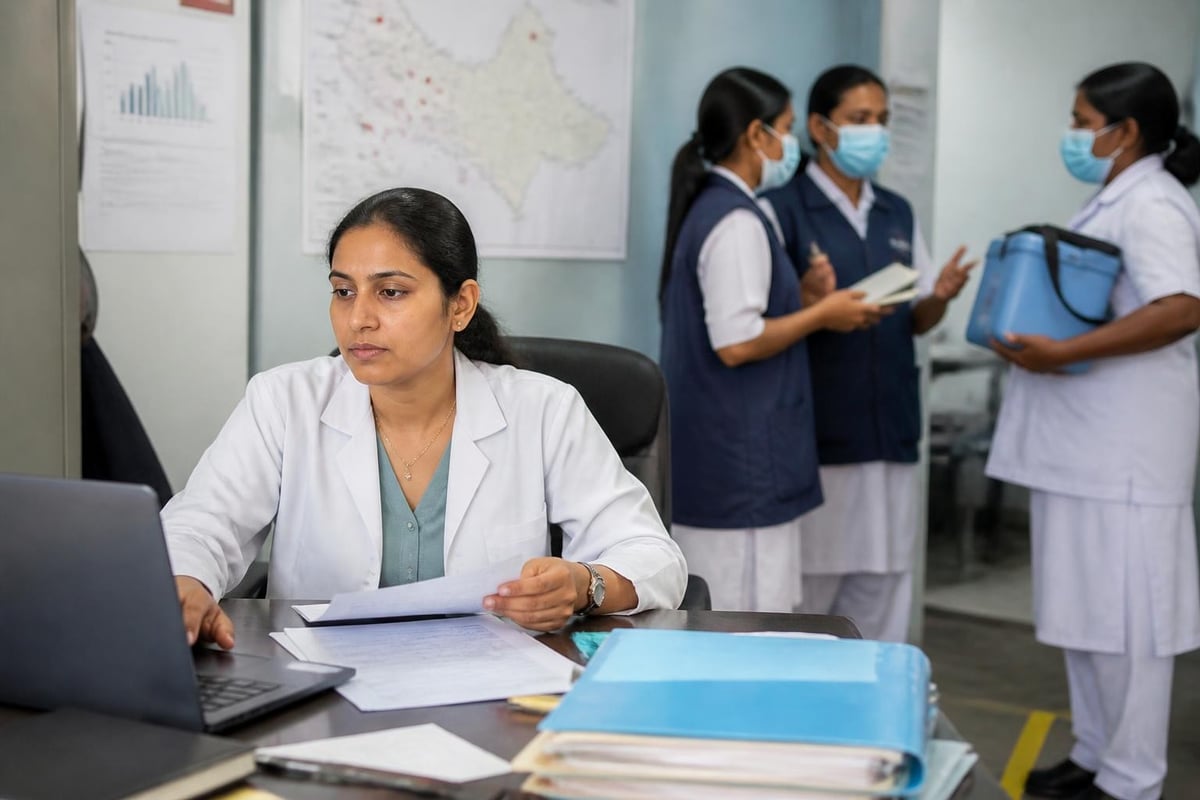
Career progression in public health often involves postgraduate qualifications (Master of Public Health, Fellowship of the Australasian Faculty of Public Health Medicine) and sustained engagement with population-level health issues. The work suits doctors who enjoy systems thinking, data analysis, and the slower burn of policy change rather than the immediacy of clinical practice.
Medical Officers in Defence and Operational Contexts
Australian Defence Force medical officers serve as military doctors embedded with Army, Navy, or Air Force units. The role combines general practice, emergency medicine, occupational health, and expedition medicine depending on deployment context. A medical officer on a naval vessel provides primary care to crew, manages acute illness and injury, and liaises with onshore specialists when a patient needs evacuation.
Training for defence medical officers includes not just clinical skills but also field operations, leadership under pressure, and understanding of military command structures. The Australian Defence Force Health Service runs specific programs for medical officer development, blending clinical competency with military readiness.
Operational deployments place medical officers in environments where resources are limited, evacuation options are constrained, and clinical decision-making carries higher stakes. A medical officer in a forward operating base might manage trauma, infectious disease, and mental health presentations with minimal backup. The breadth of practice is wider than most civilian roles, and the autonomy is considerable.
The civilian translation of these skills is significant. Medical officers transitioning out of defence often move into emergency medicine, retrieval services, or remote area practice where the ability to work independently and manage uncertainty is valued. Some transition into hospital medicine or locum work across regional facilities, where the skills developed in operational settings transfer directly to the clinical context.
Career Pathways and Training for Medical Officers
There's no single pathway to becoming a medical officer because the title encompasses multiple roles. In hospital medicine, progression typically follows intern, resident medical officer, registrar or medical officer, then consultant. Medical officers who aren't in a formal training program might remain at that level or seek fellowship through unaccredited pathways, college exams, or portfolio-based assessment.
For those interested in executive roles, transitioning to a Chief Medical Officer position usually requires 15-20 years of clinical experience, formal leadership training, and demonstrated capability in governance or administration. Many CMOs complete MBA programs, health administration qualifications, or leadership diplomas alongside clinical work. The NHS guidance on integrated care board governance outlines how senior clinical roles fit into system-level accountability structures, a framework that's increasingly relevant in Australia as primary health networks and regional partnerships evolve.
Public health pathways diverge earlier. Doctors interested in population health might complete a Master of Public Health during or immediately after prevocational training, then apply for medical officer roles in health departments or NGOs. The Australasian Faculty of Public Health Medicine offers fellowship training for those seeking specialist recognition, though many public health medical officers work outside the college system.
Defence pathways are structured differently again. Medical officers in the ADF complete initial officer training, then serve a return of service obligation in exchange for sponsorship. Some remain for entire careers; others complete a posting or two before returning to civilian practice. The skills are transferable, but the structure is distinct from hospital or public health tracks.
Locum work offers flexibility across all these contexts. Medical officers in training might locum between rotations or during dedicated research time. Experienced medical officers use locum shifts to supplement income, explore different clinical environments, or maintain skills while working part-time. Facilities benefit because they access doctors with specific competencies without committing to permanent appointments. Understanding how to make locuming work requires clarity on credentialling, rate negotiation, and rostering logistics.
Governance, Accountability, and Clinical Standards
Medical officers at any level operate within governance frameworks that define scope of practice, reporting lines, and accountability for clinical outcomes. In hospitals, this means adherence to credentialling and scope-of-practice policies, participation in clinical governance activities like morbidity meetings and incident reviews, and compliance with national safety and quality standards.
A medical officer covering an obstetrics shift needs evidence of competency in the procedures they'll perform (forceps, vacuum, caesarean section assistance), current Basic Life Support in Obstetrics certification, and agreement from the facility's credentials committee. If they're a locum, these checks happen before the first shift. Permanent staff go through the same process at appointment, with periodic revalidation.
The Springer chapter on hospital leadership and clinical governance describes how Chief Medical Officers and Medical Directors fit into these systems as both participants and overseers. They chair credentialling committees, sign off on new appointments, and respond when scope-of-practice breaches occur. The position requires clinical judgment about what constitutes safe practice and when to escalate concerns.
For government medical officers, accountability runs through different channels. A medical officer advising on pandemic response reports to the Chief Health Officer, who reports to the health minister. Independence is expected in the scientific advice, but the final policy decision sits with elected officials. The UK Chief Medical Officer's 2025 annual report illustrates how this plays out in practice, with CMOs providing evidence-based recommendations while acknowledging the political and economic constraints on implementation.
| Governance Context | Key Accountabilities | Oversight Mechanism |
|---|---|---|
| Hospital medical officer | Patient outcomes, scope adherence, documentation standards | Clinical governance committee, departmental head |
| Chief Medical Officer | System-wide safety, quality metrics, workforce governance | Board, CEO, external accreditation |
| Public health medical officer | Policy advice accuracy, program delivery, outbreak response | Chief Health Officer, ministerial briefing |
| Defence medical officer | Operational readiness, clinical capability, force health protection | Commanding officer, Defence Health Services chain |
Governance failures become visible when adverse events occur. A medical officer working outside their competency, a CMO who fails to act on emerging safety data, or a public health medical officer who misreads surveillance trends can all trigger significant harm. The structures exist to prevent this, but they depend on honesty about capability, willingness to seek help, and a culture that supports speaking up when something doesn't look right.

Workforce Trends and Future Directions
Medical officer roles are evolving in response to workforce shortages, changing models of care, and increasing demand for flexible employment. Hospitals struggle to fill permanent positions in some specialties and locations, which increases reliance on locum medical officers to maintain service continuity. This isn't necessarily a problem if the locum workforce is well-managed and properly integrated, but it does require facilities to think differently about recruitment and retention.
The shift toward portfolio careers means more doctors combine part-time clinical work, research, education, or policy roles. A medical officer might work three days in a hospital, one day in a health department, and one day writing or teaching. This pattern suits mid-career doctors seeking variety and control over their schedules, but it fragments the workforce in ways that complicate rostering and governance.
Telehealth and digital health tools are changing how medical officers deliver care, particularly in public health and rural contexts. A medical officer based in a capital city can now provide real-time support to a remote clinic via video link, review imaging, and advise on management without the patient travelling. This extends reach but requires new competencies in virtual care delivery and medico-legal clarity on where responsibility sits when care is delivered remotely.
Leadership development for medical officers is receiving more attention. Hospitals recognise that clinical expertise alone doesn't prepare someone for a Chief Medical Officer role, and structured programs are emerging to build the necessary skills. The challenge is finding time for development when clinical service demands are high and doctors are already working at capacity. Some health services build leadership training into senior registrar positions or offer secondments into executive or policy roles as development opportunities.
Future medical officer roles will likely involve more data literacy, greater exposure to multidisciplinary team leadership, and deeper engagement with value-based care models. The clinical core remains, but the context around it continues to shift. Doctors entering the workforce in 2026 can expect their careers to include roles and responsibilities that don't yet have clear names or structures, but which will still fall under the broad umbrella of what it means to be a medical officer in Australian healthcare.
Medical officer roles span clinical care, governance, public health, and leadership, each with distinct requirements and career pathways. Whether you're a hospital-based clinician, a public health advisor, or a defence doctor, the core expectation remains the same: accountability for health outcomes within a defined scope. Best Practice Medical connects doctors with locum opportunities across these contexts, handling credentialling, rostering, and placement logistics so you can focus on clinical work. If you're considering locum work or need to fill a medical officer position, the team at Best Practice Medical understands the nuances of each role and can match the right doctor to the right opportunity.