

The locum medical doctor has become a permanent fixture in Australian hospital staffing. What started as a stopgap for annual leave and sick cover is now a deliberate workforce model. In 2026, most metropolitan teaching hospitals run at least part of their roster on locum cover, and regional facilities depend on it to keep departments open. The shift is structural, not temporary. Understanding how locum work fits into a hospital career - and how facilities actually engage a locum medical doctor - matters whether you're booking your first shift or managing your fiftieth.
Why Hospitals Use Locum Medical Doctors
Public and private hospitals book locum medical doctors for different reasons, but the outcome is the same: they need a credentialled clinician who can start quickly and work safely without a six-month onboarding process.
Parental leave is the most predictable driver. When a staff specialist or registrar takes six months off, the department doesn't shut down. The roster gap gets filled by a locum medical doctor who can step into that exact role for the duration. Extended sick leave works the same way. A consultant off for three months recovering from surgery creates a rostered vacancy that someone has to cover. The hospital either splits the load across existing staff (which leads to overtime fatigue) or brings in temporary cover. Research published in 2024 points to the recruitment and retention challenges that make locum arrangements more common across health systems globally.
Workforce shortages in certain specialties also drive demand. Anaesthetics, Emergency Medicine, Psychiatry and ICU face ongoing supply constraints. When a department has an advertised full-time equivalent (FTE) position open for months without a suitable applicant, the only way to maintain service levels is to book locum cover on a rolling basis. This isn't ideal, but it's better than cancelling elective surgery or closing beds. Some regional hospitals operate entire rosters on locum arrangements because permanent recruitment in those locations has stalled.
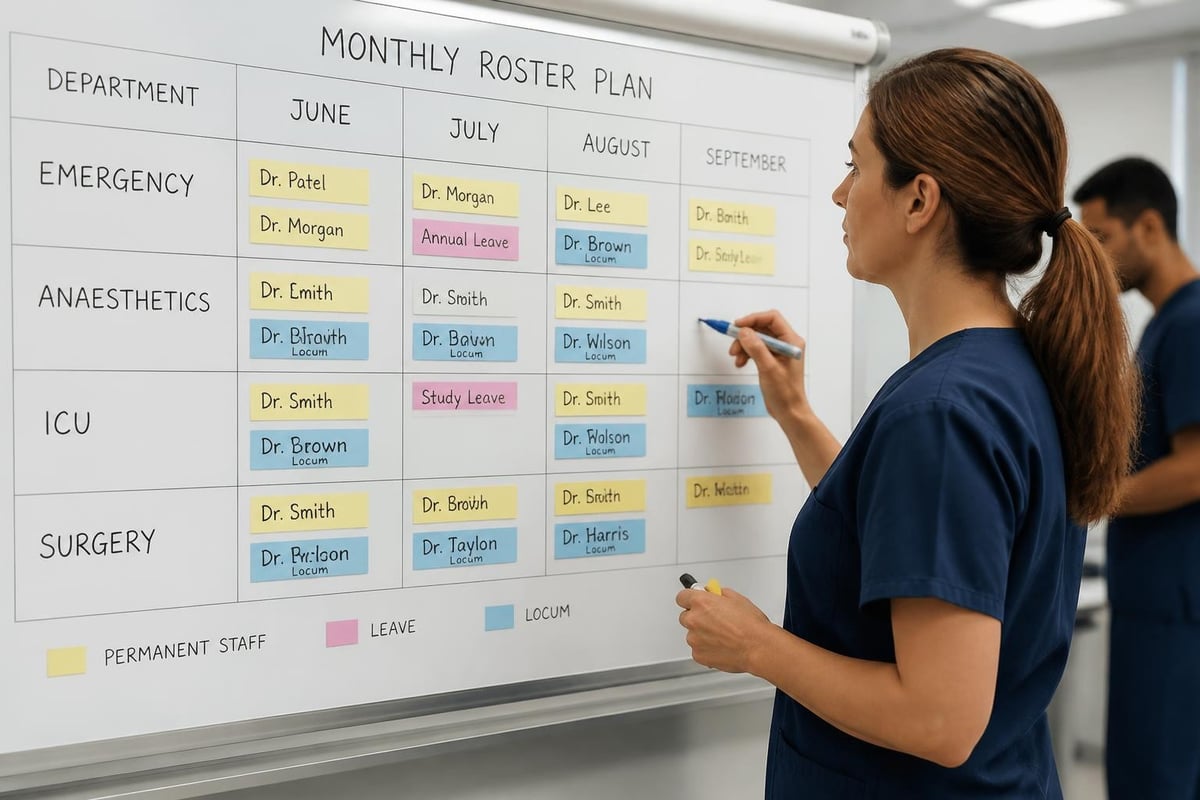
Ad hoc shifts cover the unpredictable gaps. A staff member calls in sick two hours before a shift, or an unexpected surge in ED presentations means the rostered consultant needs backup. Short-notice bookings are hard to fill, but they're also where agencies prove their worth. A hospital can call at 0600 and have a locum medical doctor on site by 0800 if the right match is available and the credentialling is already in place. Those arrangements depend on pre-verified candidate pools, not last-minute paperwork.
How Credentialling Works for Locum Medical Doctors
Every locum medical doctor goes through credentialling before they can work in a facility. The process verifies registration, indemnity, qualifications and facility-specific requirements. It's not optional, and it's not negotiable.
AHPRA registration comes first. A current, unrestricted registration with the Medical Board of Australia is the baseline. If a doctor's registration has conditions or is under review, that gets flagged immediately. Medical indemnity insurance is next. The policy must cover the scope of practice for the role being filled, and the cover needs to be current on the day the shift starts. College membership or fellowship may be required depending on the specialty and the seniority of the role. A registrar covering ICU needs CICM or equivalent training recognition. A VMO covering an anaesthetics list needs ANZCA fellowship or a pathway that satisfies the facility's credentialling committee.
Facility-specific requirements vary. Some public hospitals require a Working with Children Check even if the doctor isn't working in paediatrics. Others mandate specific infection control training or orientation modules before the first shift. Private hospitals often have stricter credentialling timelines because their insurers demand it. The NHS guidance on locum engagement outlines similar standards for revalidation and supervision when doctors move between short-term placements.
Before any doctor is placed, Doctor Credentialling and Compliance Verification happens in-house. AHPRA registration, medical indemnity insurance, relevant college memberships and facility-specific requirements are all verified. The process is managed internally, with Brad Nelmes - a practising clinician - overseeing credentialling standards. ISO 9001:2015 certification means the process is independently audited annually, so hospitals know the documentation is current before the doctor arrives on site.
| Credentialling Component | Verification Timeframe | Responsible Party |
|---|---|---|
| AHPRA registration | 24–48 hours | Agency or hospital |
| Medical indemnity | 24–48 hours | Agency or hospital |
| College membership | 2–5 business days | Agency or hospital |
| Facility orientation | On arrival or pre-shift | Hospital |
| Department-specific competencies | First shift or pre-arranged | Hospital/supervisor |
The credentialling burden sits with whoever is organising the placement. If a doctor books directly with a hospital, the hospital's medical workforce unit handles it. If an agency is involved, the agency does the verification and submits the documentation to the hospital for final approval. Either way, no locum medical doctor starts a shift without a credentialling file that satisfies the facility's governance requirements.
Contracts, Pay and Employment Status
A locum medical doctor works under one of two arrangements: as a contractor invoicing the facility (or an agency), or as a temporary employee on the hospital's payroll. The distinction matters for tax, super and indemnity.
Contractors are the most common model. The doctor operates as a sole trader or through a company, invoices for hours worked, and is responsible for their own tax and superannuation. Pay rates are higher than salaried equivalents because the rate includes a loading to cover leave entitlements, super and administrative overhead. A registrar on a locum contract might invoice at $150–$200 per hour depending on specialty and location, compared to a salaried registrar earning an effective rate of $90–$110 per hour once leave and super are factored in. The BMA's locum handbook provides a detailed breakdown of how contract terms, tax obligations and indemnity interact in the UK system, and the principles apply equally in Australia.
Temporary employment is less common but still used, especially in public hospitals where payroll systems are already set up to onboard casual staff. The doctor is paid through the hospital's payroll, receives superannuation contributions, and is covered by the hospital's indemnity arrangements for the work performed. The effective hourly rate is lower, but the administrative burden is reduced. The doctor doesn't invoice, doesn't chase payment, and doesn't need separate professional indemnity beyond their standard policy.

Both models have advantages. Contractors have more control over their schedule and can structure their income tax more efficiently if they're working regularly. Temporary employees have fewer administrative tasks and clearer entitlements if something goes wrong. The choice often comes down to what the facility offers rather than what the doctor prefers. Public hospitals lean toward payroll; private hospitals and day surgeries lean toward contractor arrangements.
Payment terms vary. Most agencies pay the doctor within 7–14 days of the shift being completed, regardless of when the hospital pays the agency. That's a service the agency provides - it absorbs the cash flow risk. Direct hospital bookings typically pay within 30 days, sometimes longer if the invoice gets caught in a bureaucratic approval loop. Doctors working multiple short-term contracts need to track their own receivables or work with someone who does. Late payment is common enough that it's worth confirming terms before the shift starts. More detail on how to make locuming work can help doctors navigate the practical side of contract work.
What Makes a Locum Medical Doctor Effective
The clinical skill set is assumed. No one is booking a locum medical doctor who can't do the job. What differentiates a good locum from a problematic one is adaptability, communication and documentation.
Adaptability means working within the systems and culture of the facility without needing extensive handholding. Every hospital has its own EMR, its own referral pathways, its own unwritten rules about when to escalate and when to manage independently. A locum who can orient quickly, ask the right questions early, and integrate into the team without friction is more likely to be re-booked. Facilities remember the locums who caused problems - not because they were incompetent, but because they didn't adapt to how that department operates.
Communication with permanent staff matters more than most locums realise. A registrar covering an ICU night shift needs to know who the consultant on call is, what the thresholds are for calling them, and what the morning handover expectations are. A VMO covering a surgical list needs to brief the anaesthetist, communicate with theatre staff, and document the plan clearly so the post-op team knows what to expect. Poor handover from a locum creates risk, and risk creates complaints. The hospital won't re-book someone who left the next shift scrambling to piece together what happened overnight.
Documentation standards don't drop just because the doctor is temporary. Notes need to be complete, legible (or typed), and filed in the correct system before the shift ends. Discharge summaries need to be sent. Referrals need to be actioned. If a locum medical doctor finishes a shift and leaves incomplete documentation, the permanent staff have to clean it up - and that reflects poorly on both the doctor and whoever placed them. Facilities that depend on locum cover expect the same documentation quality they'd get from a permanent staff member. That's non-negotiable. Understanding what makes a good locum doctor helps both doctors and facilities set the right expectations upfront.
How Facilities Source Locum Medical Doctors
Hospitals and day surgeries source locum medical doctors through three main channels: internal pools, direct recruitment and agency partnerships. Each has trade-offs.
Internal pools are doctor databases maintained by the hospital's medical workforce unit. These are clinicians who have already been credentialled, have worked in the facility before, and can be contacted directly when a shift becomes available. The advantage is speed and familiarity. The doctor knows the department, the hospital knows the doctor, and credentialling is already complete. The disadvantage is limited reach. If no one in the internal pool is available, the facility has to look elsewhere.
Direct recruitment happens when a hospital advertises a locum position publicly or contacts doctors directly. This works for planned, long-term cover where there's time to run a proper recruitment process. It's less effective for short-notice shifts or roles that require niche skills. A hospital looking for a locum intensivist to cover three months of parental leave might advertise and interview candidates. A hospital needing an anaesthetist for tomorrow morning's list doesn't have that luxury.
Agency partnerships are the most common solution for short-term and specialist placements. The agency maintains a credentialled pool of doctors across multiple specialties and can match a facility's need with an available candidate quickly. The hospital pays a margin for that service, but the trade-off is administrative efficiency and risk transfer. If the doctor doesn't show up, the agency is responsible for finding a replacement. If the credentialling is incomplete, the agency carries the liability. Preferred supplier arrangements streamline this further. Facilities that have already onboarded an agency through a government procurement panel or private hospital group can start booking without a new tender process. For more on why facilities turn to locum recruitment, the decision often comes down to speed, compliance and continuity.
| Sourcing Method | Typical Use Case | Credentialling Lead Time | Cost to Facility |
|---|---|---|---|
| Internal pool | Short-notice shifts, repeat bookings | Already complete | Nil (direct engagement) |
| Direct recruitment | Long-term planned cover | 2–4 weeks | Recruitment/advertising cost |
| Agency partnership | Short-term, specialist, or urgent cover | 48 hours–1 week | Agency margin (15–30%) |
The choice depends on urgency, budget and administrative capacity. A well-resourced metropolitan teaching hospital might use all three methods depending on the role. A regional hospital with limited HR capacity will default to an agency for almost everything.
Rostering and Shift Coordination
A locum medical doctor doesn't just turn up and hope for the best. Someone has to coordinate the roster, confirm the booking, arrange site access and ensure the clinical handover happens. That coordination work is often invisible until it doesn't happen.
Roster planning starts weeks or months in advance for predictable gaps. A consultant taking parental leave from March to August gives the roster coordinator time to source a locum, complete credentialling and arrange orientation. The locum medical doctor receives a confirmed booking with dates, shifts, pay rate and reporting details. There's a start date, an end date, and a named supervisor. Everything is documented before the first shift.
Short-notice shifts are messier. A call comes in at 0600 for a shift starting at 0800. The agency checks availability, confirms the doctor's credentialling status, notifies the facility and arranges site access. The doctor receives a booking confirmation by SMS or email with the shift details, the ward or department location, and a contact number for when they arrive. There's no time for a formal orientation, so the doctor gets a verbal handover from whoever is on site. It's functional, but it's not ideal.
Clinical handover is where coordination often breaks down. The outgoing doctor finishes a night shift, hands over to the locum medical doctor starting the day shift, and expects them to pick up seamlessly. If the handover is verbal only, details get missed. If it's documented but the locum doesn't know where to find it, the same problem occurs. Good coordination ensures the locum knows what the handover process is before the shift starts, not during it. A quick phone call or email the day before can prevent confusion and clinical risk.
Interstate and Regional Placements
A locum medical doctor covering a regional or interstate shift faces logistical challenges that don't exist in metro work. Travel, accommodation, unfamiliarity with the facility and isolation from usual support networks all add friction.
Travel coordination is the first hurdle. A doctor flying from Sydney to Broken Hill for a week-long ICU placement needs flights booked, ground transport arranged and a clear arrival plan. If the hospital expects the doctor to arrive by 0800 and the only flight lands at 0730, someone has miscalculated. Regional placements require buffer time for travel delays, especially in areas with limited transport options. Interstate placements add complexity around credentialling reciprocity. A doctor registered in NSW working a shift in Queensland needs to confirm that their indemnity covers interstate work and that the facility's credentialling requirements don't include state-specific mandates.
Accommodation is the second issue. A doctor working a block of shifts in a regional hospital needs somewhere to stay that isn't a backpacker hostel. The hospital may provide on-site accommodation, or the agency may arrange a serviced apartment or hotel room. Either way, the doctor needs to know where they're staying before they leave home. Poor accommodation creates dissatisfaction and reduces the likelihood of re-booking. A doctor who spent a week in substandard housing isn't coming back, regardless of the pay rate.
Orientation and clinical support matter more in unfamiliar environments. A locum medical doctor walking into a regional ED for the first time doesn't know the referral pathways, the retrieval protocols or the on-call roster. A structured orientation - even if it's just a one-hour handover - makes a measurable difference. The hospital benefits because the doctor is functional faster, and the doctor benefits because they're not guessing their way through the first shift. The WHO's health workforce resources discuss the global dimensions of temporary clinician mobility and the importance of support structures when doctors move between unfamiliar health systems.
Compliance, Governance and Quality Assurance
Every locum medical doctor placement carries governance risk. The facility is responsible for ensuring the doctor is qualified, credentialled and supervised appropriately. The doctor is responsible for working within their scope and escalating when needed. When something goes wrong, both parties are scrutinised.
Credentialling documentation is the first line of defence. If a locum medical doctor makes a clinical error and the subsequent review finds that their credentials were never properly verified, the hospital's governance team has a problem. If the doctor's indemnity policy didn't cover the procedure they performed, the hospital may be liable. Proper documentation before the shift starts - not after the incident - is what protects everyone involved. The U.S. National Practitioner Data Bank guidelines detail the importance of verifying temporary privileges and querying centralised databases before granting clinical access.
Supervision requirements vary by role and specialty. A locum registrar in a teaching hospital works under the same supervision model as a permanent registrar. A VMO working independently in a private hospital has different oversight expectations. The facility needs to clarify what supervision is available and what escalation pathways exist before the shift starts. A locum medical doctor who isn't sure when to call for help is a liability, not an asset.
Quality assurance processes apply to locum placements the same way they apply to permanent staff. Incident reports, clinical audits and peer review don't stop because the doctor is temporary. If a locum is involved in a significant clinical event, the facility's quality and safety team will investigate. The doctor's agency or the hospital's medical workforce unit may also conduct a parallel review. Repeat issues with the same locum medical doctor lead to de-credentialling and removal from the available pool. Facilities track performance, and doctors with poor track records don't get re-booked.
Why Agencies Exist in This Market
Hospitals could, in theory, recruit and credential every locum medical doctor themselves. Some do. But most don't, because the administrative overhead outweighs the cost saving. Agencies exist because they solve a coordination problem that hospitals don't want to manage in-house.
Speed is the main value add. An agency with a pre-credentialled pool can fill a shift in hours. A hospital running its own recruitment process for the same shift might take days or weeks. When a department needs cover for tomorrow morning's list, the hospital doesn't have time to advertise, shortlist, interview and credential. They call an agency, confirm availability, and move on. The agency has already done the credential verification, so the hospital just needs to approve the booking and arrange site access. For guidance on how facilities can hire casual staff efficiently, the processes around credentialling, rostering and compliance are key.
Risk transfer is the second value. If a locum medical doctor cancels at the last minute, the agency is responsible for finding a replacement. If the doctor's credentials turn out to be incomplete, the agency carries the reputational and legal risk. The hospital pays a margin for that transfer, but the trade-off is certainty. A facility booking directly with a doctor has no fallback if something goes wrong. A facility booking through an agency has a contracted service level and recourse if it isn't met.
Administrative efficiency is the third factor. An agency handles rostering, invoicing, payment follow-up and dispute resolution. The hospital's medical workforce unit doesn't need to chase a locum for incomplete documentation or follow up on an unpaid invoice. The agency does that. For a hospital managing dozens of locum shifts per month, outsourcing that coordination frees up internal capacity to focus on permanent recruitment and workforce planning. The margin paid to the agency is offset by the reduction in internal administrative cost.
Locum medical doctor placements are now a permanent feature of hospital workforce planning in Australia. Credentialling, contracts, rostering and clinical handover all need to work properly for the arrangement to succeed. Facilities that depend on locum cover need agencies that can verify credentials quickly, match the right doctor to the right role and manage the logistics without adding risk. Best Practice Medical connects exceptional doctors with extraordinary locum opportunities across Australia, offering tailored services for medical staffing with thorough candidate screening and fast, precise placement systems backed by ISO 9001:2015 certification.